In plain English
- What happened
- OpenAI's gpt-oss models are published under the Apache 2.0 license, which lets anyone download and run them commercially at no charge. That has revived a question owners keep asking: should a small business run its own model to save money? The published prices say no for almost everyone. A rented RTX 4090 costs $0.74 an hour on Runpod; Anthropic's smallest model costs $1 per million input tokens.
- Why it matters to your business
- Running your own model means hardware, maintenance, and somebody accountable when it breaks at nine at night, costs that never appear in the comparison you are shown. Open weights make self-hosting possible. They do not make it cheap or simple, and at small-business volumes the per-word price is almost always lower than the per-hour one.
- Do this
- Do the first step below this week. If your total AI spend is under a few hundred dollars a month, close the tab and put the hours into the workflow instead of the infrastructure.
The pitch is easy to fall for. The model is free. You already pay for AI. Therefore running the free model yourself should be cheaper. The first two statements are true. The third skips every number that matters.
What the rental actually costs
A single consumer-grade GPU is the cheapest realistic way to run a capable open model. On Runpod's published pricing as of September 2026, an RTX 4090 with 24 GB of memory is $0.74 an hour, an RTX A6000 with 48 GB is $0.53, and an L40S is $1.09. A model that has to answer a customer at any hour has to be running at any hour. At $0.74 an hour, 24 hours a day, 30 days a month, that is $532.80 before you have sent a single request.
You can turn it off at night and eat a cold start each morning. You can buy the card outright and put it under a desk. Both are real options, and both add a person who has to manage them.
What paying per word costs
The hosted alternative is priced by the million tokens, where OpenAI's own rule of thumb is that a token is roughly three-quarters of a word. Anthropic's current list price for its smallest model, Haiku 4.5, is $1 per million input tokens and $5 per million output tokens; Sonnet 5, the mid-tier, is $2 and $10. Our arithmetic, not theirs: a business that sends and receives five million tokens a month, which is around 3.7 million words, would pay in the low tens of dollars on Haiku. To spend $532 a month on Haiku you would need to process roughly 100 million words.
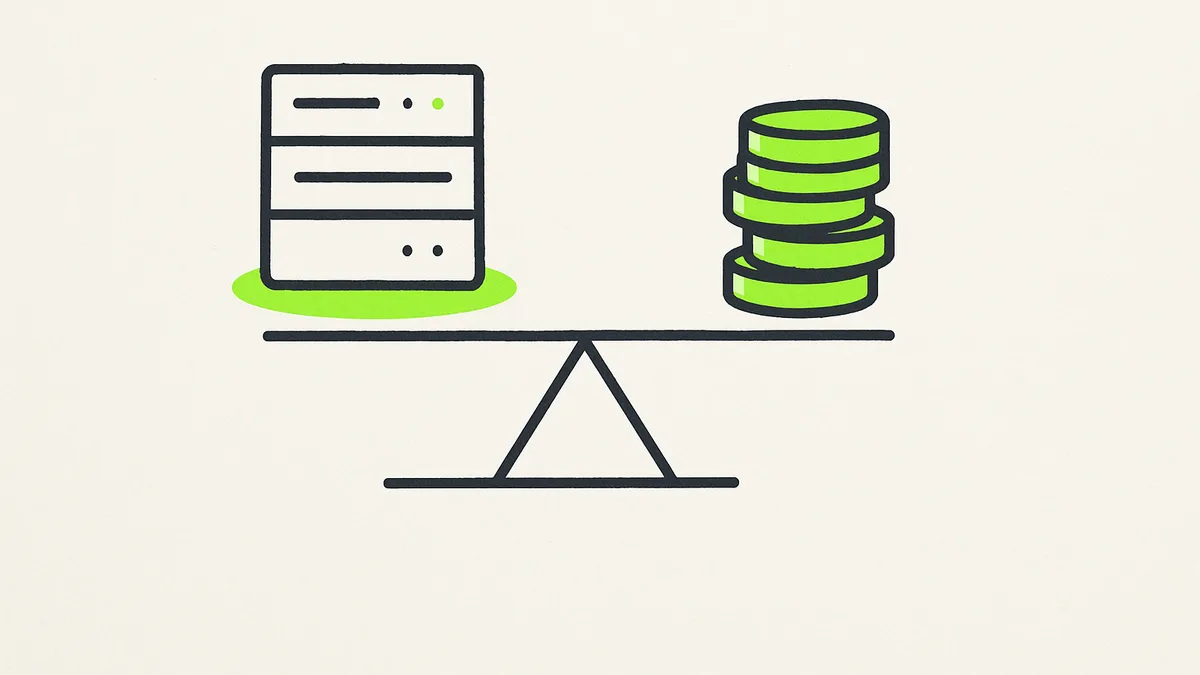
$532.80 a month is the rental for one always-on RTX 4090. At Haiku 4.5 list prices, that same money buys on the order of 100 million words of processing. Most small businesses are nowhere near that.
The three questions that settle it
- 1
Add up what you actually spend
Every AI subscription and API bill, one month, real numbers from the invoices. Most small businesses land under a few hundred dollars and are surprised by how low it is. If that number is below the rental figure above, the comparison is already over.
- 2
Price the hardware honestly
Rented or bought, a GPU is a monthly number that does not go away when you are not using it. Add electricity if it is under your desk. Add the second machine if the first one cannot go down.
- 3
Name who maintains it
Updates, outages, security patches, the morning it stops responding. If the honest answer is you, add the hours at your rate to the cost. If the honest answer is nobody, that is the answer.
When it does make sense
There are honest cases. If your data cannot leave your building for legal or contractual reasons, the price comparison is irrelevant and self-hosting is the only option. If you are processing very large volumes of text on a schedule, batch work that can run overnight on a card you already own, the per-hour price can win. And if you are a software business whose product is the model, the calculation is a different one entirely.
None of those describes a bakery, a realtor, a contractor or a consultant using AI to draft emails, summarise documents and answer customer questions. For that business, the model is not the expensive part and never was.
Reality check
Open weights being free is the most misleading fact in AI right now. The model costs nothing; running it is the entire expense. Anyone quoting you a self-hosting saving without a per-hour hardware number and a named person to maintain it has not done the arithmetic.
Sources